Aarav loved exploring places that other people ignored.
While his friends preferred playing cricket in the park, Aarav liked following little trails, looking under fallen branches, and wondering where an old path might lead.
One Saturday morning, he was visiting his grandfather’s village when he noticed something unusual.
Behind the garden was a narrow path covered with tall grass.
“Where does that go?” Aarav asked.
His grandfather looked toward the path.
“That’s the old hill trail,” he said. “Nobody uses it much anymore.”
“Why not?”
“Because it doesn’t lead anywhere.”
Aarav smiled.
“Maybe nobody has followed it far enough.”
His grandfather laughed.
“Perhaps.”
That was all Aarav needed to hear.
After lunch, he packed a bottle of water, two biscuits, and a small flashlight into his backpack.
He followed the trail.
At first, it was easy.
The path passed between tall trees and wildflowers. Birds hopped from branch to branch, and somewhere nearby, a stream made a soft rushing sound.
After about twenty minutes, the trail became harder to see.
Aarav pushed aside a few branches.
Then he noticed something scratched into the bark of an old tree.
It was an arrow.
Aarav looked around.
Another arrow was carved into a tree farther ahead.
“Someone else came this way,” he whispered.
He followed the arrows.
They led him up the hill and around a large rock.
Then the trees suddenly opened.
Aarav stopped.
In front of him was a dark opening in the side of the hill.
A cave.
He had never seen it before.
A cool breeze came from inside.
Aarav switched on his flashlight and stood at the entrance.
He remembered his grandfather’s advice: “An explorer should be curious, but never careless.”
So he didn’t go deep inside.
Instead, he carefully looked around the entrance.
That’s when he spotted something half-buried beneath the leaves.
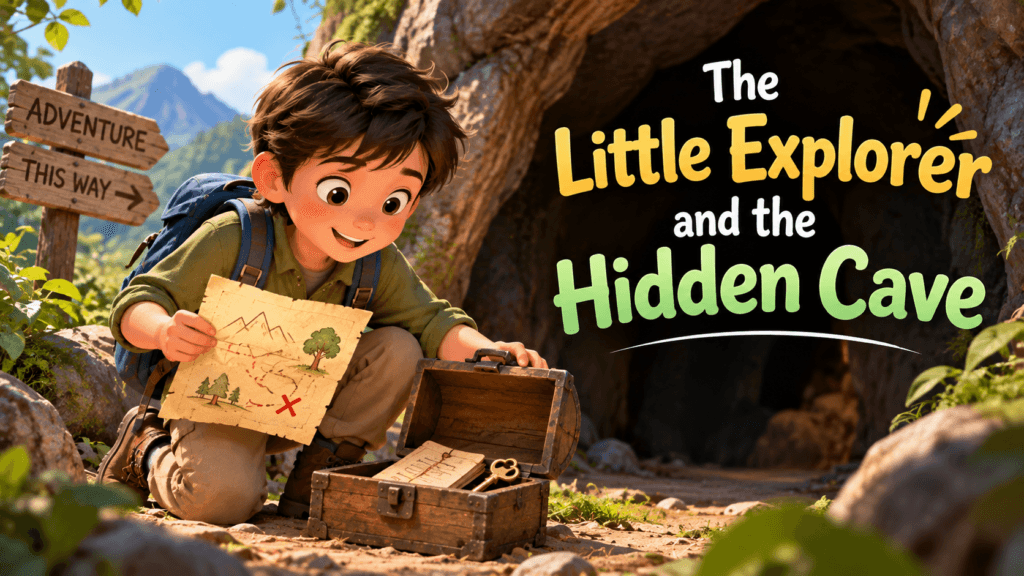
A small wooden box.
Aarav picked it up.
It was old and covered in mud, but a little metal latch still worked.
Inside was a folded piece of paper and a tiny brass key.
Aarav unfolded the paper.
There was a simple drawing of the hill.
At the bottom someone had written:
“The cave keeps a secret, but the secret isn’t gold.”
Aarav frowned.
“What kind of secret isn’t gold?”
He looked into the cave again.
Near the entrance, he noticed three small stones arranged in a line.
Behind them was another arrow.
It pointed toward a crack in the rock.
Aarav carefully moved closer.
Behind the crack was a small wooden door.
He couldn’t believe it.
There was a keyhole.
The brass key from the box fit perfectly.
Click.
The door opened.
Inside was a tiny room.
There were no jewels.
No treasure chest.
No gold coins.
Instead, there were shelves covered with old notebooks.
Aarav opened the first one.
It belonged to a young boy who had lived in the village many years earlier.
The notebook was filled with drawings of birds, plants, insects and animals.
There were notes about where different birds built their nests and which flowers appeared after the monsoon.
Aarav turned another page.
At the top, the boy had written:
“If people learn about this forest, perhaps they will take better care of it.”
Aarav smiled.
That was the secret.
The cave wasn’t hiding treasure.
It was hiding knowledge.
He carefully closed the notebook and took a few pictures with his grandfather’s old camera, which he had brought along.
Then he headed home.
When Aarav showed his grandfather what he had found, his grandfather became very quiet.
“You found it,” he said.
“You knew about the cave?”
“I knew there was an old study room somewhere on the hill. My schoolteacher told me about it when I was young. But I never found the entrance.”
Aarav opened the notebook.
“Can we take care of these?”
His grandfather nodded.
“That’s exactly what they were meant for.”
The next morning, Aarav and his grandfather returned to the hill.
They carefully collected the old notebooks and brought them back to the village.
Aarav’s grandfather spoke to the village schoolteacher, who helped preserve the notebooks.
Soon, the children at the school began learning about the birds, plants and animals that lived around the hill.
And Aarav?
He still loved exploring.
But from that day on, he understood something important.
Being an explorer isn’t always about finding something valuable. Sometimes it’s about discovering something worth protecting.
The End
What is the lesson of the story?
The Little Explorer and the Hidden Cave reminds children that curiosity and responsibility go hand in hand. Aarav discovers that a true treasure doesn’t have to be gold or jewels. Knowledge, nature and things that help others can be even more valuable.
Want to make a story personal?
Create a personalized kids story with a child’s name and favorite theme on Kids Story Online.